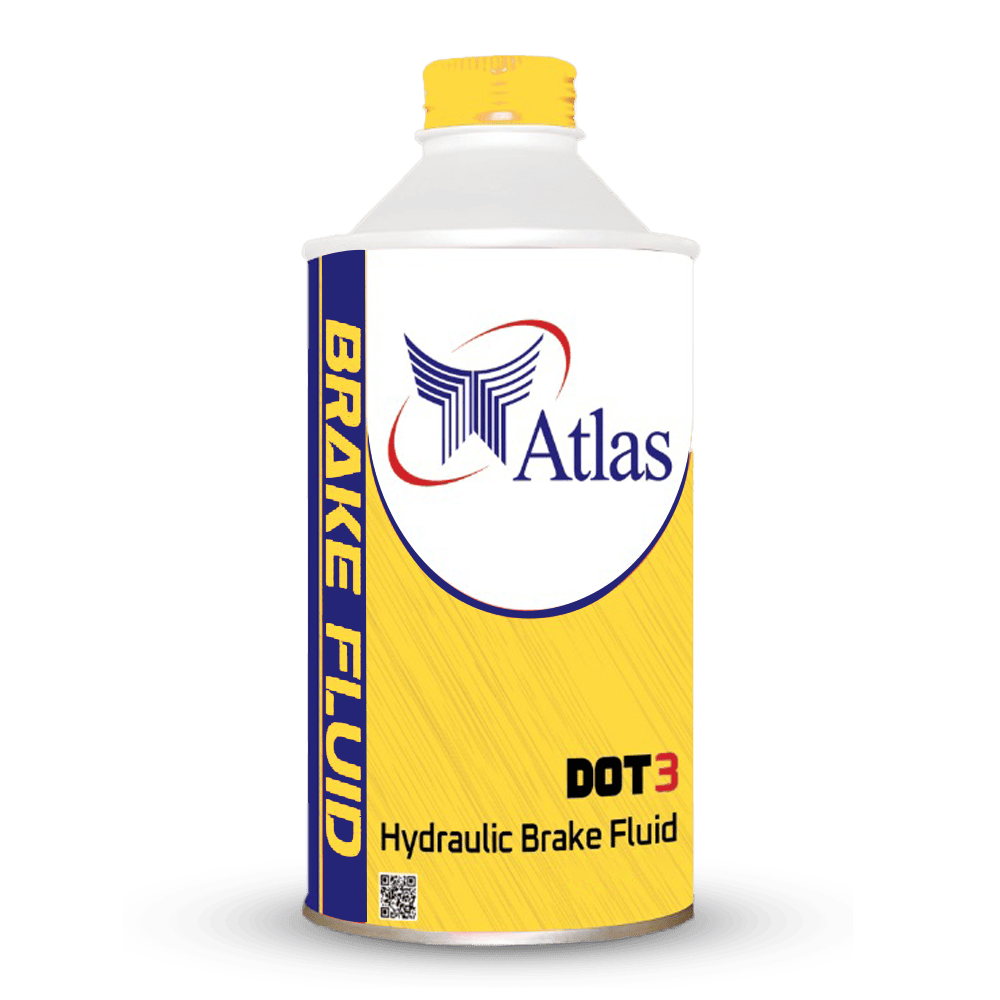

DOT 3 Brake Fluid

Product Description

Atlas DOT 3 Brake Fluid is a premium quality glycol-ether-based formulation designed for use in conventional hydraulic brake and clutch systems. It meets and exceeds FMVSS 116 DOT 3, SAE J1703, and ISO 4925 specifications.

This non-petroleum formulation is engineered to provide safe, reliable braking performance, even under demanding conditions, by preventing vapor lock and protecting braking components from corrosion.

Applications

Designed for use in hydraulic brake and clutch systems of cars, motorcycles, trucks, buses, and other vehicles where DOT 3 fluids are specified.

Not suitable for systems requiring mineral oil-based or silicone (DOT 5) brake fluids.

Available In

350ML & 208L


Category:

Features & Benefits

  • High boiling point to reduce the risk of vapor locking.

  • Compatible with all conventional DOT 3 brake fluids.

  • Provides strong corrosion protection for metal brake components.

  • Formulated for stability under both high and low temperatures.

  • Ensures safe and responsive braking performance.

  • Reduces brake fade under high-temperature conditions.

  • Protects against rust, corrosion, and moisture absorption.

  • Extends the service life of braking system components.

Typical Characteristics

Properties Test Method Values (Typical)
Appearance Visual Light amber
Specific Gravity at 15 °C g/ml ASTM D-4052 1.125
Kinematics Viscosity at 100 °C, mm2/sec ASTM D-445 2.02
Equilibrium Reflux Boiling Point °C SAE J 1703 215
Wet Boiling Point °C SAE J 1703 149
pH Value —- 8.3

The typical characteristics mentioned represent mean values.

Safety, Health and Environment

  • Atlas DOT 3 Hydraulic Brake Fluid unlikely to have any significant health or safety hazard when properly used in recommended application and follow good standards of personal hygiene.

  • Avoid prolong contact with skin. Use impermeable gloves while handling oil. After skin contact, wash with soap and water.

  • All packages should be stored under cover. Where outside storage is unavoidable drums should be laid horizontally to avoid the possible ingress of water and the obliteration of drum markings.